The Bumpy, Sweet History of Grüner Veltliner
In a first of its kind, this month’s sip will focus on the history of a grape varietal dear to our hearts: Grüner Veltliner (pronounced "Groo - Ner Velt - Leaner").
Spoiler alert: A scandal in the 1980s almost permanently wiped Austria from the world of wine. Without Austria, Grüner Veltliner would likely never have become an international grape. And you would have never had the opportunity to try our most popular wine, our Sta Rita Hills Grüner Veltliner.
We promise this Sip is worth the time it will take to read it…
The Origin
Let’s start with the grape itself.
The varietal Grüner Veltliner is a cross between Savignon (also known as Traminer, which my parents recently planted on their farm in Maryland), and St. Georgen, a nearly extinct varietal.
Grüner Veltliner likely originated in the Danube region of lower Austria, a few centuries ago, and today most of the world associates Grüner Veltliner with Austrian wine.
Grüner really took off in the 1950s and became 1/3 of Austrias entire vineyard within a few decades.
However, Austria did not yet have much of its own reputation in the 1980s.
Most winemakers exported bulk, inexpensive sweet and semi-sweet wine to Germany, where people had a huge appetite for sweet wines, called Auslese and Spatlese styles.
Sweet wines require very ripe grapes, though, and ripe grapes require warm growing seasons. 1970s and 1980s Austria did not have reliably warm growing seasons (today with climate change is a very different story).
To maintain their exports, Austrian winemakers sought out methods & tricks to achieve the ripe, rich, and honeyed flavor profiles loved by German consumers. In a trend all too common with the wine industry over the past 50 years, they turned to chemical additives...
The Scandal
Note: We won’t belabor this point in this month’s newsletter, but chemical additives are still a huge problem in the world of wine today. While it’s rare for a boutique producer to use most additives, many bulk wines found in grocery stores and corner stores across the country rely heavily on additives to maintain consistency while producing at scale.
Some Austrian winemakers discovered a specific chemical additive, Diethylene Glycol, worked exceedingly well. It added the body, residual sweetness, and viscosity that a very ripe Grüner Veltliner or Riesling grape can get during a warm growing season. It was very difficult for a human palate to identify, and wine analysis labs at the time didn’t screen for it.
Another common product that uses Diethylene Glycol? Antifreeze, used for cars. Diethylene Glycol is also toxic to humans in sufficient doses, although the amount added to the wines was unlikely to ever reach that level.
Unfortunately, this practice happened for years before it was discovered.
The favored myth is that a wine producer tried to claim a huge amount of antifreeze / Diethylene Glycol purchases on their tax returns despite only owning a single tractor, which caused the tax bodies to investigate.
Whether that is true, one way or another the authorities in West Germany learned about this practice and started screening for the chemical compound. It was quickly discovered in a wide range of wines and a huge international backlash followed.
Within the year, countries across Europe were seizing thousands of bottles and other countries like Japan banned Austrian wine imports altogether. Austrian wine exports collapsed over 90% in one year, and took over 15 years to recover.
The Recovery
To save their wine industry, Austria reacted by passing some of the strictest wine laws in the world. They mandated specific yields, laboratory testing, traceability, and certification.
These stringent requirements flipped the economics of Austrian wine.
Manufacturing cheap bulk wine was no longer profitable. The only way to justify the investment on meeting the regulations became producing quality wine that could sell at a higher price.
A generation of winemakers beginning in the late 1980s embraced this and defined a new generation of Austrian wines marked by quality.
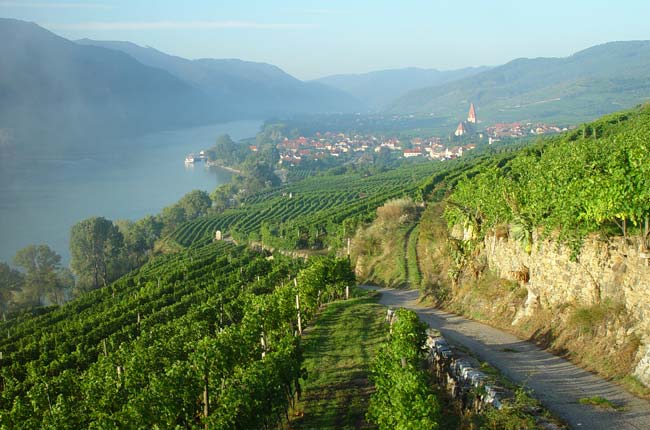
The Wachau region of Austria (pictured above), known for its steep rocky terrain, became the pre-eminent region in Austria producing Grüner Veltliner wines known for concentration, acidity, and minimality.
As food culture in the 1990s took off, Grüner Veltliner’s eminence grew. In 2002, this came to a head when Jancis Robinson and Tim Atkin organized a blind tasting in London placing top Austrian Grüner Veltliners against top white Burgundies (Chardonnay from Burgundy, France).
Austrian wines took most of the top placings.
Grüner Veltliner Today
Today, quality Grüner Veltliner wine is famous all over the world for its versatility with foods. It’s still synonymous with Austria, and aged Grüner Veltliners are found across wine cellars of serious collectors all over the world.
However, we find that the climate and soil of the Sta Rita Hills, outside of Santa Barbara California, are also a uniquely wonderful place for growing Grüner Veltliner.
It’s not common.
Every year, California publishes the tonnage of every grape grown in the state and Grüner Veltliner was less than 1% in 2025.
Showcasing the beauty of wine varietals outside of the norm is one of the raisons d’être of VOON, and we hope that you enjoyed learning about the history of our best-selling wine today.
Cheers,
Evan & Cameron